




Vulnerability testing is the process of identifying security weaknesses in systems, applications, and networks using automated scanning tools. These tools compare your infrastructure against databases of known vulnerabilities, flagging potential issues based on software versions, configurations, and exposed services. While vulnerability testing provides valuable baseline visibility into your security posture, it represents only the first step in a comprehensive security program.
Understanding what vulnerability testing can and cannot do is essential for making informed security decisions. Organizations that mistake vulnerability scans for complete security assessments leave themselves exposed to attacks that automated tools cannot detect.
What are Vulnerability Assessments?
A vulnerability assessment is a systematic review of security weaknesses across your environment. The terms vulnerability testing and vulnerability assessment are often used interchangeably, though assessment sometimes implies a broader scope that includes policy review and risk analysis alongside technical scanning.
Vulnerability assessments typically produce reports listing discovered weaknesses, their severity ratings (often using CVSS scoring), and remediation recommendations. These reports help security teams prioritize patching efforts and track remediation progress over time. Regular vulnerability assessments form the foundation of a vulnerability management lifecycle, enabling organizations to measure their security posture and demonstrate compliance with regulatory requirements.
How Does Vulnerability Testing Work and Where Does It Fall Short?
Asset Identification and Discovery
The vulnerability testing process begins with discovering what exists in your environment. Scanners perform network mapping to identify live hosts, open ports, and running services. This discovery phase creates an inventory of assets to test, including:
- Servers, workstations, and network devices
- Web applications and APIs
- Databases and storage systems
- Cloud resources and containers
- Wireless access points and IoT devices
Vulnerability Scanning and Analysis
Once assets are identified, vulnerability scanners probe each system to detect weaknesses. Scanners check for:
- Missing security patches and outdated software versions
- Default or weak configurations
- Known CVEs (Common Vulnerabilities and Exposures)
- Insecure protocols and cipher suites
- Compliance violations against security benchmarks
Results are compiled into reports that categorize findings by severity, typically using CVSS scores to prioritize remediation efforts. Security teams then analyze results, validate findings, and create remediation plans.
Where Vulnerability Testing Falls Short
Vulnerability testing identifies potential weaknesses but cannot determine whether those weaknesses are actually exploitable in your specific environment. A vulnerability that scores critical in isolation may be mitigated by compensating controls, while a medium-severity finding might provide the exact foothold an attacker needs.
Automated scanners also cannot detect business logic flaws, novel vulnerabilities (zero-days), or complex attack chains that require human creativity to discover. They test against known signatures, missing the unknown threats that sophisticated attackers exploit.
Vulnerability Testing vs Penetration Testing
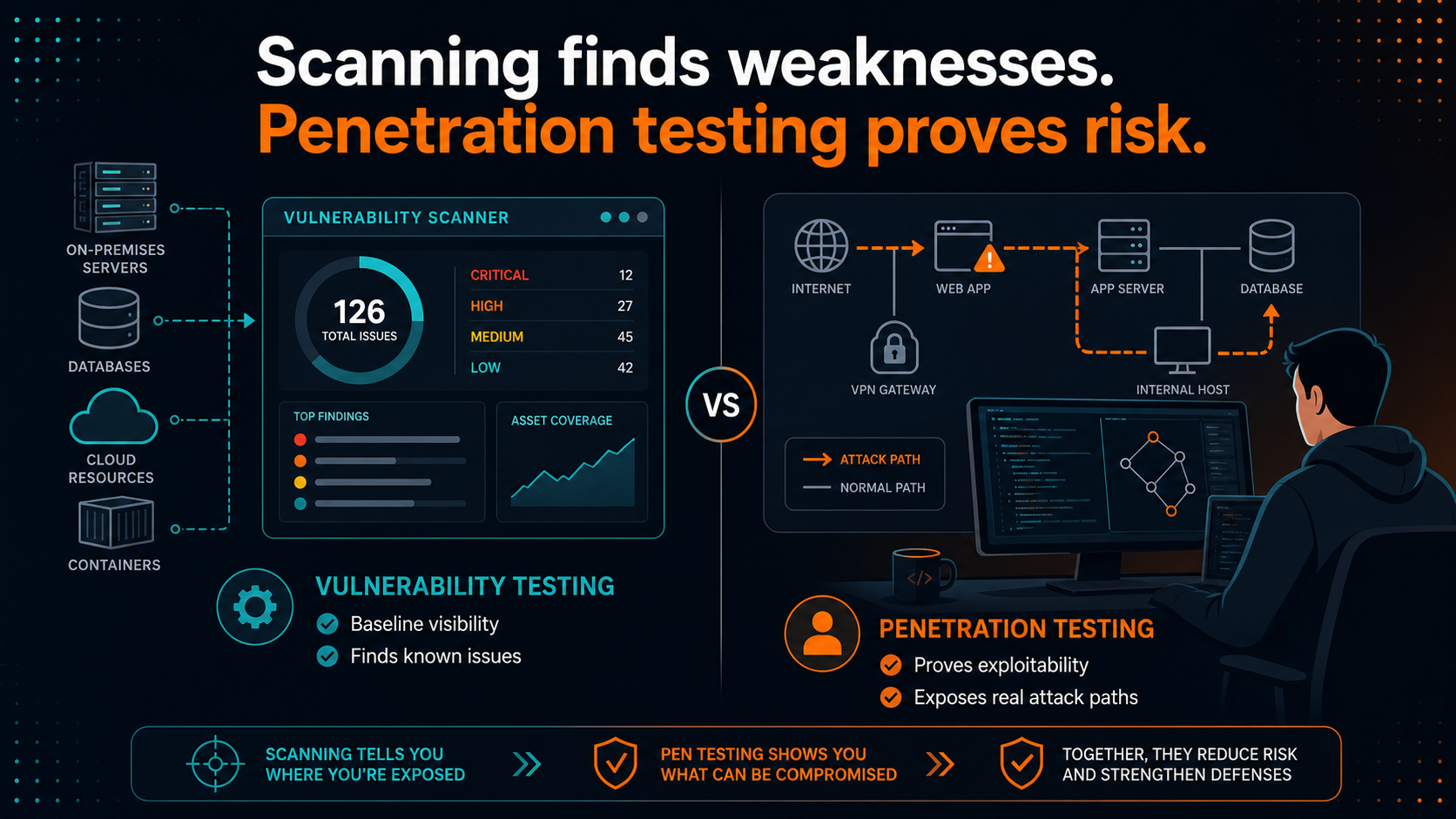 The distinction between vulnerability testing and penetration testing is fundamental yet frequently misunderstood. Vulnerability testing identifies potential weaknesses; penetration testing proves whether those weaknesses can actually be exploited and demonstrates the real-world impact of successful attacks.
For a detailed comparison, see our guide on penetration test vs vulnerability testing.
When to Use Vulnerability Testing
Vulnerability testing is appropriate for:
- Regular, ongoing monitoring of your security posture
- Patch management validation after deploying updates
- Compliance requirements that mandate periodic scanning
- Baseline assessments before deeper security testing
- Tracking remediation progress over time
When to Use Penetration Testing
Penetration testing is essential when you need to:
- Validate whether vulnerabilities are actually exploitable
- Understand the real-world impact of security weaknesses
- Discover business logic flaws and novel attack vectors
- Test detection and response capabilities
- Map the Path to Compromise showing how attackers reach sensitive data
- Satisfy compliance requirements that specifically mandate penetration testing
Common Vulnerabilities
Vulnerability assessments consistently identify similar categories of weaknesses across organizations:
Missing Patches and Outdated Software
Unpatched systems remain the most common vulnerability category. Effective patch management requires tracking software versions across your environment and prioritizing updates based on exploitability and business impact. Scanners excel at identifying missing patches by comparing installed versions against vendor security advisories.
Weak Authentication and Access Controls
Default credentials, weak password policies, and excessive privileges create opportunities for attackers. Vulnerability testing identifies accounts using common passwords, services with default configurations, and systems lacking multi-factor authentication. However, testing the full impact of compromised credentials requires penetration testing.
Insecure Network Services
Legacy protocols transmitting data in cleartext, unnecessary services exposed to the network, and misconfigured firewalls all create attack surface. Port scanning identifies exposed services, while deeper analysis reveals whether those services use secure configurations and up-to-date encryption.
Vulnerability Testing Tools
Different tools target different components of your infrastructure:
Network Vulnerability Scanners
Network scanners assess infrastructure components including servers, workstations, routers, switches, and firewalls. They identify missing patches, insecure configurations, and exposed services across your network. Common examples include Nessus, Qualys, and OpenVAS.
Web Application Scanners
Web application scanners use DAST (Dynamic Application Security Testing) techniques to probe running applications for vulnerabilities like SQL injection, cross-site scripting, and authentication flaws. SAST (Static Application Security Testing) tools analyze source code during the software development life cycle. Both approaches have value but cannot replace manual application security testing.
Wireless Network Scanners
Wireless scanners identify access points, evaluate encryption strength, and detect rogue devices. They assess whether wireless networks are properly segmented from sensitive internal resources and identify configuration weaknesses that could allow unauthorized access.
Database Scanners
Database vulnerability scanners check for missing patches, default accounts, excessive privileges, and insecure configurations specific to database platforms. They help ensure that systems storing your most sensitive data meet security baselines.
Limitations of Vulnerability Testing
Understanding what vulnerability testing cannot do is as important as understanding what it can:
False Positives
False positives are a persistent challenge in automated vulnerability scanning. These tools often report issues that either do not exist or are not exploitable within the context of a specific environment, forcing security teams to spend valuable time validating results. Organizations without deep expertise may end up allocating resources to remediate non-issues while genuine vulnerabilities remain unaddressed. This challenge is compounded by the growing volume of findings, according to the 2026 Verizon Data Breach Investigations Report, organizations experienced a 50% year-over-year increase in critical vulnerabilities, with a median remediation time of 43 days. Penetration testing mitigates this problem by validating risk through real-world exploitation, where findings are confirmed based on whether an attack succeeds or fails.
Does Not Simulate Real-World Attacks
Vulnerability scanners check for known weaknesses against signature databases. They cannot think creatively, chain vulnerabilities together, or discover novel attack paths. Real attackers adapt to your specific environment, exploit trust relationships, and find ways through defenses that automated tools never consider.
Requires Follow-Up Testing
Vulnerability testing answers the question “what weaknesses might exist?” but not “can attackers actually compromise our systems?” Organizations that stop at vulnerability scanning have incomplete visibility into their actual risk. Penetration testing provides the follow-up validation that transforms theoretical vulnerabilities into actionable intelligence.
Choosing Between Automated Scans and Manual Testing
The choice is not either/or. Effective security programs use both approaches for their respective strengths:
- Automated vulnerability testing provides continuous, cost-effective monitoring of known weaknesses
- Manual penetration testing validates exploitability and discovers what automation misses
- Together, they provide comprehensive coverage that neither achieves alone
Organizations often run vulnerability scans monthly or quarterly while conducting annual penetration tests. Critical systems may warrant more frequent penetration testing, especially after significant changes.
Integrating Penetration Testing With Vulnerability Testing with Netragard
Vulnerability testing tells you what might be wrong. Penetration testing services from Netragard tell you what attackers can actually do with those weaknesses.
Since 2006, Netragard has delivered genuine, human-driven penetration testing that goes far beyond automated scanning. Our Real Time Dynamic Testing methodology validates vulnerability scan findings, eliminates false positives, and discovers the business logic flaws and novel attack vectors that scanners miss entirely.
We recommend using vulnerability testing for ongoing monitoring and our penetration testing services for periodic deep validation. This combination provides both continuous visibility and the expert analysis needed to understand your true security posture. Request a Quote to discuss how we can help integrate penetration testing into your vulnerability management program.