You’ve invested in security tools, built processes, trained a team, and survived a few audits. The real question is: can all of that stop a determined, stealthy attacker who only needs one good way in? Our Red Team Services are full-scale, objective-driven attack campaigns that put your defenses and your defenders to the test against experienced operators who think like adversaries.
We don’t run noisy scans, dump a laundry list of findings, and call it “red teaming.” We act like a sophisticated threat with a clear objective: find a viable entry point, move laterally, and see how far we can go before your team notices, responds, and shuts us down. You get the uncomfortable truth about how your security program holds up when someone is actively trying to bypass it.
Discover whether a determined attacker can achieve the objective, not just uncover isolated weaknesses.
People, Processes, and Technology in realistic attack scenarios.
Organizations with mature security programs and detection capabilities.
Compromise specific accounts, access sensitive data or proprietary source code, test detection & response, bypass security controls.
Executive summary, attack narrative, technical findings, timeline, and actionable guidance.
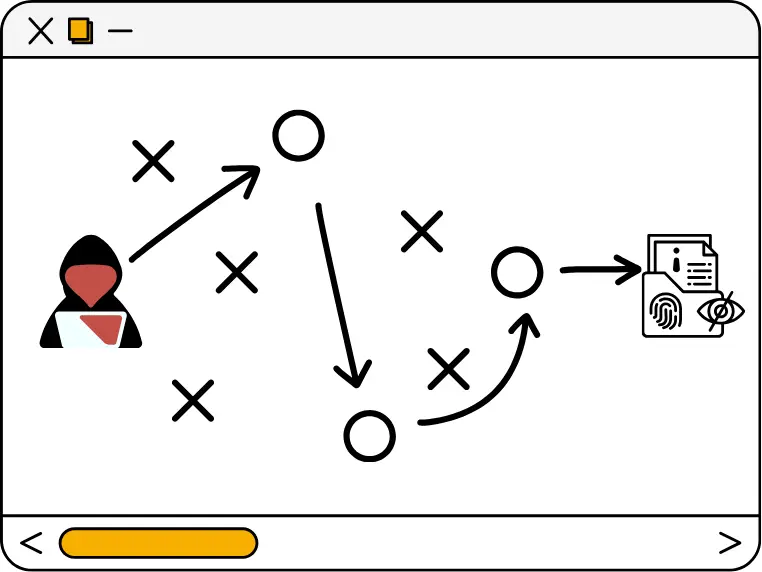
Red Teaming is an objective-driven security assessment where we go after what matters – a specific admin account, the CEO’s inbox, proprietary source code, or the ability to move money. One target. One goal. No checklist.
From there, everything is about reaching that objective. We find a path, stay quiet, and adapt until we either get what we came for or get caught. The question isn’t how many weaknesses exist—it’s whether they can be chained into a meaningful compromise before your people, processes, and technology stop us.
Our Ruby Red Team exercises are built for organizations that already have baseline security in place and want to see how it performs under pressure. If you’re confident in your defenses and want to validate them against realistic attack behavior, this is where you stop guessing and start measuring.
Every engagement starts with your objectives. Maybe you want to know whether ransomware operators could reach core infrastructure, whether a targeted attacker could compromise M365 or cloud administration, whether social engineering could open the door, or if your SOC can detect lateral movement before critical assets are touched. We shape the operation around those goals, define rules of engagement, and build a threat-informed attack plan that fits your environment and risk profile.
Every Ruby Red Team engagement starts by defining the mission. We work with you to identify what success looks like from an attacker’s perspective, whether that means reaching sensitive data, compromising a privileged account, gaining access to a critical system, or quietly living inside your environment long enough to stage follow-on objectives.
We also establish the rules of engagement up front. That includes scope, guardrails, approved attack paths, and limits around activities like social engineering, wireless, or physical access so the exercise stays realistic, controlled, and aligned with your risk tolerance. You get realistic pressure without real-world chaos.
Once the objective is clear, we build a threat-informed plan around your environment. We map out potential entry points, trust relationships, likely misconfigurations, high-value assets, and detection choke points. The goal is not to throw every technique at the wall and see what sticks. It is to design a campaign that is focused, realistic, and tailored to the way a threat attacker would pursue the objective inside your environment.
When the operation begins, we behave like attackers, not auditors. We perform reconnaissance, gain a foothold, move laterally, escalate access where possible, and work toward the agreed objective while trying to stay blended in with normal activity.
If a path is blocked, we adapt. If a control fires, we adjust. If one attack vector fails, we pivot to another. This is not a hit-and-run exploit demo; it’s a structured, controlled stress test of your entire defensive stack.
The real value of a red team exercise is not just whether we get in. It is whether your defenders detect the activity, investigate it correctly, escalate it appropriately, and contain it before the objective is achieved.
We measure where visibility was missing, where signals were lost in noise, how long it took to recognize the activity as a real incident, and how effectively containment and response actions were carried out. The result gives you a practical view of defensive resilience that dashboards and maturity scores simply don’t offer.
When the operation wraps, you get a clear, attack narrative of what happened. The end result is not a script to a horror movie. It’s a practical roadmap for upgrading your security from “we hope this works” to “we’ve seen this type of attack before and know how to handle it.”
Explains how far the attack got, what was at risk, and what that means for the business in plain language.
Shows how we gained access, moved, escalated, and tried to reach the agreed-upon objectives, including evidence at each step.
Highlights missed opportunities, false positives, process breakdowns, and places where you’re already strong.
Close gaps, improve visibility, refine playbooks, and make life significantly harder for the next attacker who tries the same tricks.
Plenty of firms say “red team” and then deliver a dressed-up pentest. We design Ruby Red Team engagements to look and feel like what keeps your CISO up at night, not what satisfies a compliance checklist.
Real-world exploitation, attack path mapping, and custom tooling.
We chain vulnerabilities and misconfigurations into compromise scenarios instead of counting how many we can find.
Our attacks and recommendations are grounded in how your infrastructure works, not how a generic template thinks it does.
Every recommendation is tied to something we did, something your defenders saw or missed, and a clear path to making that attack harder next time.
If you want to know how a real attacker would operate in your environment – and whether you can stop them – Netragard’s Ruby Red Team Services are built for you.