


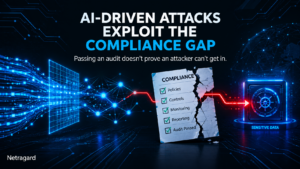


There isn’t a single correct cadence that fits everyone. The right answer is unique to your organization, its culture, and its environment.
Most articles about penetration testing frequency lead with a number. Annual. Quarterly. Continuous. The number changes depending on who’s selling the service. The truth is, there is no single answer that fits all organizations.
The frequency at which you test is unique to your organization. It’s dependent on what you’re testing, what type of tests you’re running, what your threat model looks like, and what your auditors, board, and engineering teams need to see.
This article walks through how to think about penetration testing frequency in real terms and how to find the right cadence for you. What drives the cadence question, what the major compliance frameworks actually require, and how to tell the difference between a cadence that improves your security posture and a cadence that exists strictly for compliance. Our assumption throughout is that real security is the priority, not a check in the box.
More testing doesn’t equate to better security, testing the right way for your organization does.
Ideal Penetration Testing Frequency
The baseline is annual testing with additional testing after every significant change. The right cadence is whatever your risk profile demands.
For your baseline you should run a full-depth penetration test annually at minimum, and run another test after any significant change to your environment. That’s the baseline everyone should meet, regardless of industry, size, or compliance pressure.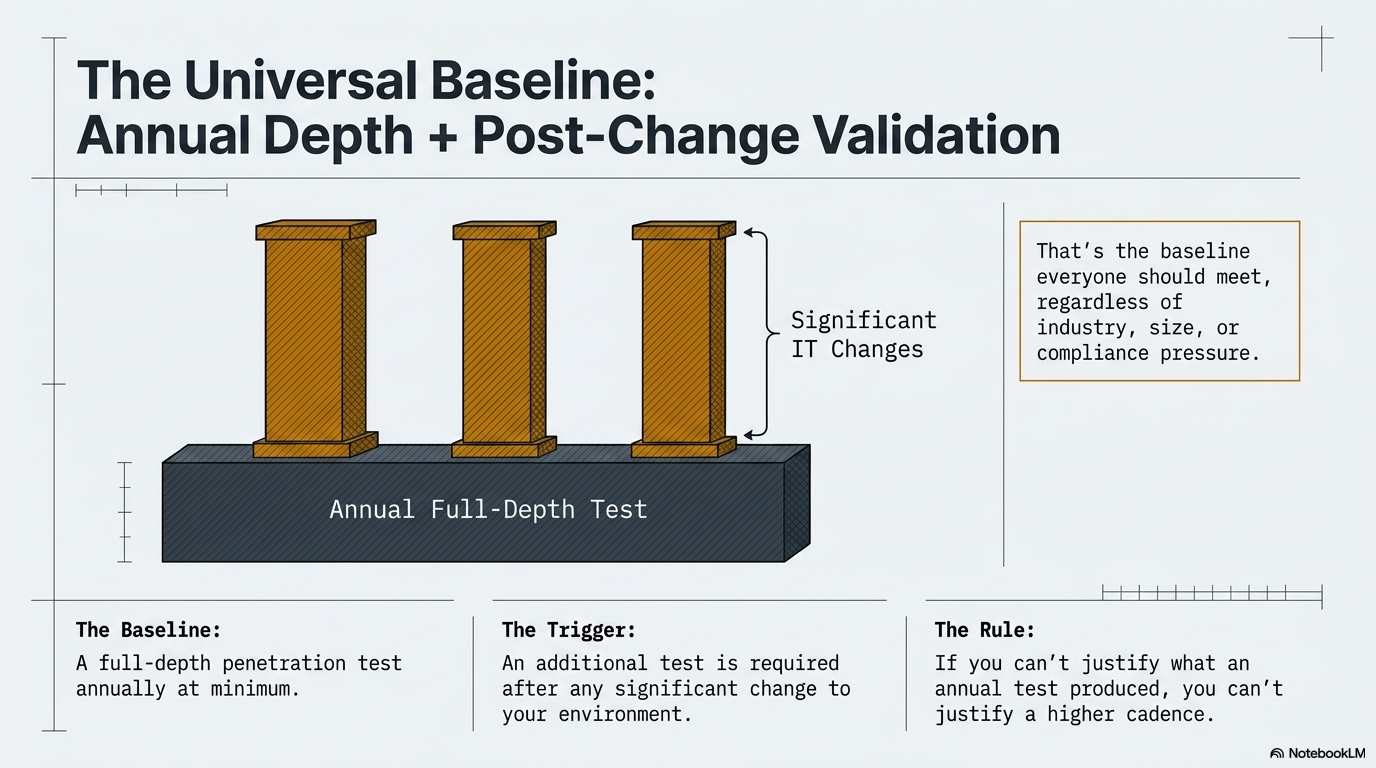
Above the baseline, cadence depends on what you’re trying to accomplish. A single high-quality annual test produces more security value than four compliance tests quarterly. The compliance tests will produce a higher volume of findings, but those findings are typically low value and do little to improve your security posture. A genuine penetration test will produce findings that matter to your organization and map to real adversary capability and to specific Paths to Compromise (PTCs) through your environment. The depth of a single genuine test pays off throughout the year while compliance tests stop paying off the moment the box is checked.
For many organizations annual testing is far from sufficient. A platform that ships weekly, a financial services firm under DORA, a healthcare network managing high-risk ePHI, or a critical infrastructure operator will all need testing more frequently than the baseline. The frequency answer for those organizations isn’t more tests of the same depth; it’s a layered cadence of full-depth manual testing supplemented by appropriate automated or continuous capability between engagements.
The ROI of doing it right is equal to the cost in damages of a single successful compromise.
Drivers of Pentesting Frequency
Five things drive how often you should test, and what your vendor wants to sell you isn’t one of them.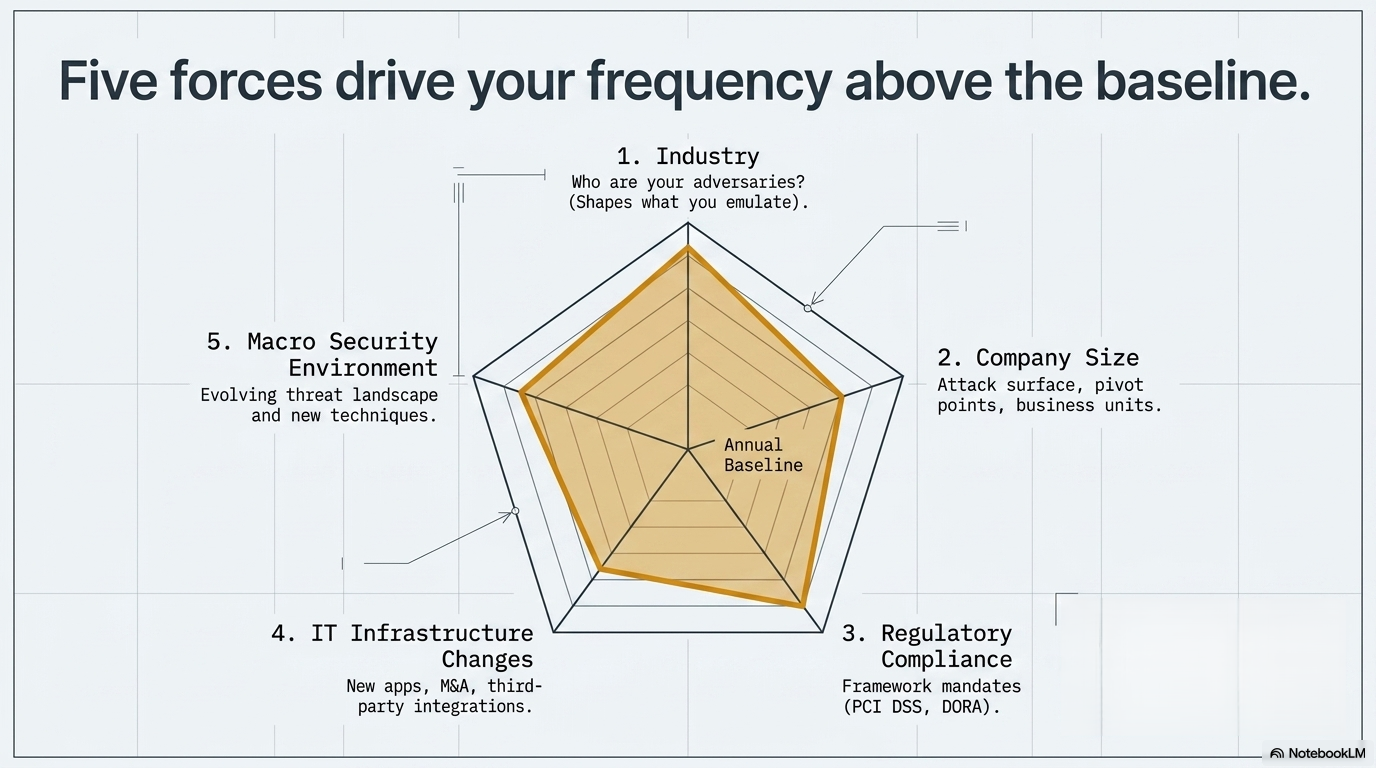
Industry
In large part, your industry and data determine who your adversaries are. Financial services and healthcare face nation-state actors, organized crime, and high-volume credential-theft campaigns. Software and SaaS companies face supply chain attackers and targeted intrusion. Retailers face card-data theft and ransomware. Defense contractors face state-sponsored threats. The industry shapes who’s coming for you, and who’s coming for you shapes what your tests need to emulate.
Company Size
Larger organizations have more attack surface, more pivot points, and more business units that may each warrant their own scope. They also typically have more sophisticated internal defenders. A fifty-person company and a fifty-thousand-person enterprise both need penetration testing, but the scope, depth, and cadence will differ materially. Larger organizations often run multiple tests per year across different scopes (external infrastructure, internal infrastructure, web applications, social engineering, cloud, segmentation) rather than one omnibus test.
Regulatory Compliance
Most major frameworks require penetration testing as part of a documented security program, but they vary in how prescriptive they are about frequency. PCI DSS v4.0 is the most explicit: at least annually plus after every significant change, with segmentation testing every six months for service providers. SOC 2, HIPAA, GDPR, GLBA, and ISO 27001 generally expect annual testing as a baseline but leave the precise cadence to the organization’s documented risk analysis. DORA, for financial entities in the EU, requires threat-led penetration testing on a multi-year cycle with formal scoping.
IT Infrastructure Changes
Every significant change, and sometimes even small changes, make your existing threat model obsolete. New applications, infrastructure migrations, mergers and acquisitions, third-party integrations, and access changes all introduce new attack surface and break the assumptions baked into your last test. A test conducted before the change can’t validate the change. Post-change testing closes the blind spot between scheduled engagements. Build ad-hoc testing capacity into your program, not just scheduled testing.
Macro Security Environment
As the threat landscape evolves new attack techniques emerge, new threat actors target you and new vulnerabilities that impact your stack are disclosed. A cadence locked at annual irrespective of what’s happening externally is a cadence that misses inflection points. When the macro signal changes materially, your testing schedule should adapt to reflect it. For this reason cadence is a living number rather than a date in your calendar.
Frequency of Manual vs Automated Penetration Testing
Manual and automated testing are not interchangeable and operate on different clocks.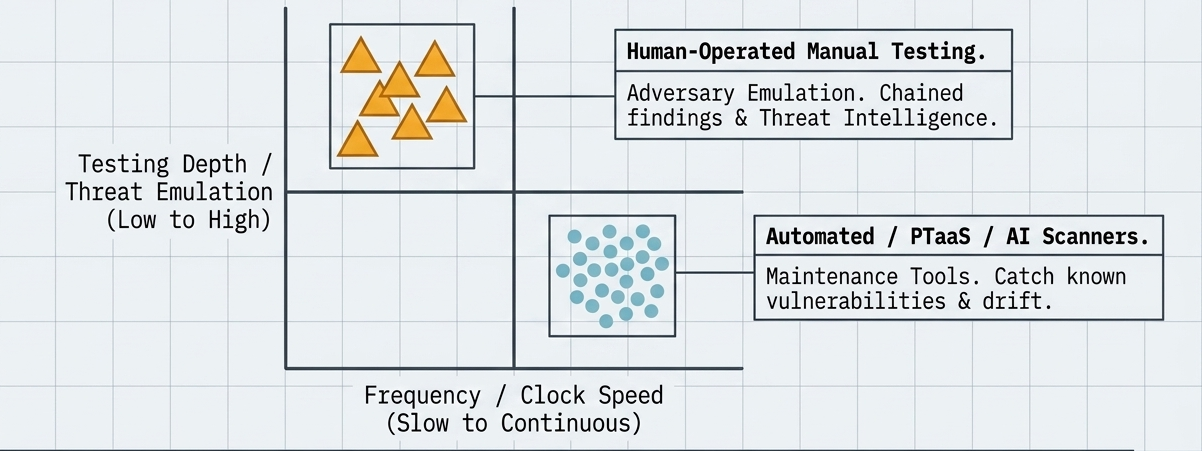
Automated testing, including vulnerability scanning, PTaaS offerings, and AI-driven testing, runs on a continuous or near-continuous cadence. These are maintenance tools that catch known vulnerabilities, configuration drift, and surface-level changes between genuine penetration tests. They’re useful as part of an ongoing security program and they reduce the window of exposure on the issues they can detect. Using them as a replacement for genuine testing will quickly turn into an expensive mistake.
Manual penetration testing, performed by human operators emulating real-world threat capabilities, runs on a slower cadence, which is right cadence for what it does. A real test chains findings into a documented Path to Compromise while accounting for attacker behavior, not just vulnerabilities. It produces contextualized threat intelligence that a customer can use to build effective defenses along the attacker’s likely paths. None of that is something you compress into a continuous cadence.
Manual and automated testing are complementary, not competing, each solving a different problem on a different clock.
Any provider pitching continuous testing or quarterly testing as a substitute for genuine penetration testing should be avoided. Continuous offerings involve automated scanning or AI with periodic manual review. They have their place, but one is like testing armor with a squirt gun while the other uses real ammunition.
Pentesting Frequency Intervals
Each interval answers a different question, so pick based on what you’re trying to accomplish, not what your vendor’s trying to sell.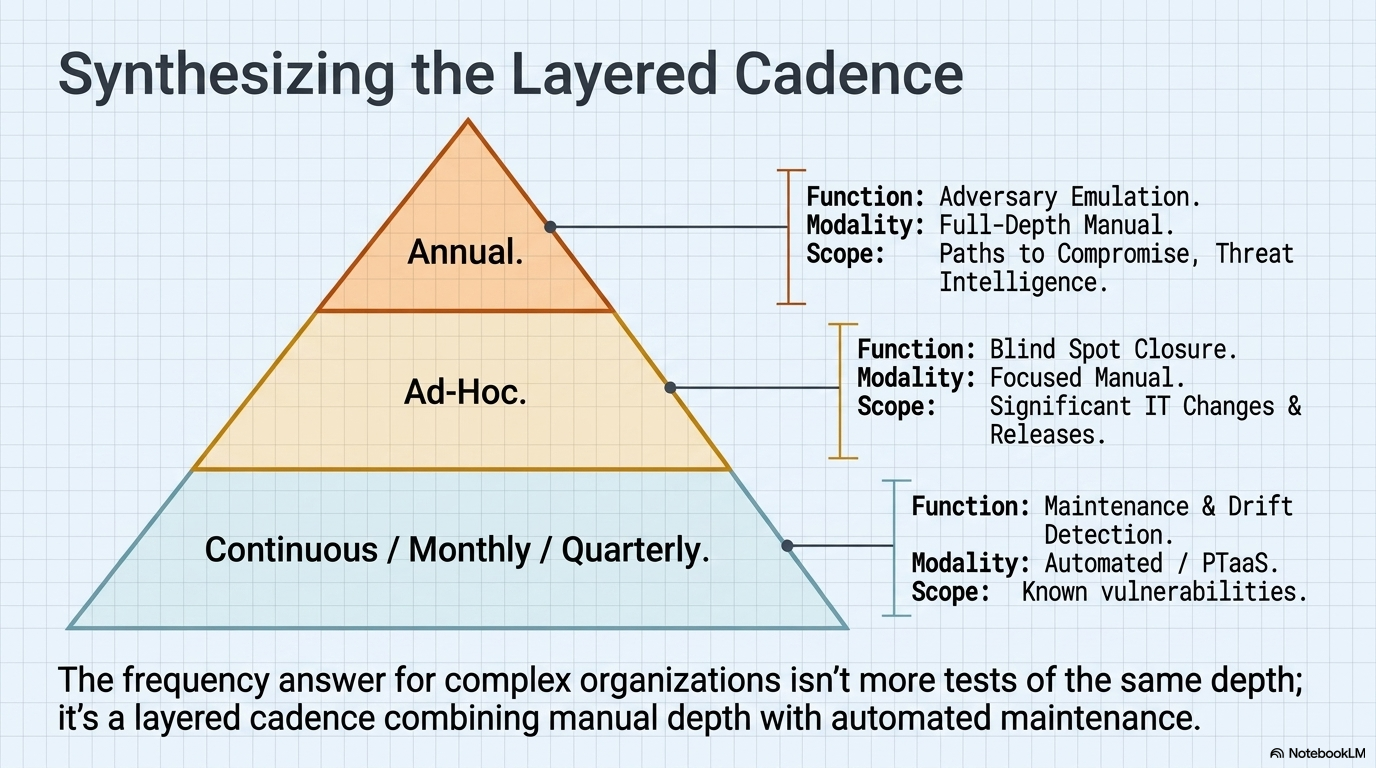
Annual Penetration Testing
Annual testing is the baseline and the workhorse. It produces the most depth per engagement, the strongest evidence for auditors, and the cleanest signal for executive risk conversations. A single high-quality annual test is the baseline against which all other cadences should be measured. If you can’t justify what an annual test produced, you can’t justify a higher cadence.
Quarterly Penetration Testing
Quarterly testing gets sold as a step up from annual, but it usually isn’t. Most quarterly tests are automated scans with a manual review pass, some don’t even have the manual review. They are useful for catching configuration drift and known-vulnerability exposure between manual engagements but are not equivalent to adversary emulation. If you’re being offered quarterly testing in place of annual deep testing, the right question to ask is what the actual depth of each test is.
Monthly Penetration Testing
Monthly cadence is appropriate for vulnerability management and configuration drift detection. No human operator team can sustain monthly depth against a complex environment at the level a real penetration test demands. Monthly cadence at depth is a marketing claim. Monthly cadence at scanning is a useful operational practice. Know which one you’re buying.
Continuous Penetration Testing
Continuous testing is also a security maintenance tool. It’s typically packaged as PTaaS or AI-driven testing, and gives you near-real-time signal on known vulnerabilities and configuration drift between real penetration tests. It’s a useful complement to manual adversary emulation, not a replacement for it. Buy it as maintenance instrumentation for your security program, not as a substitute for the contextualized threat intelligence a real penetration test delivers.
Ad-Hoc Penetration Testing
Ad-hoc testing is what you do after a significant change, after a security incident, after a major release, or before a high-stakes launch. It isn’t a substitute for scheduled testing, but it is how you avoid the blind spot between scheduled engagements. Every meaningful penetration testing program should include ad-hoc capacity, not just calendar-driven testing.
Develop an Optimal Pentesting Cadence with Netragard
A real cadence comes from a conversation about your environment, your threat profile, and what each test is meant to prove.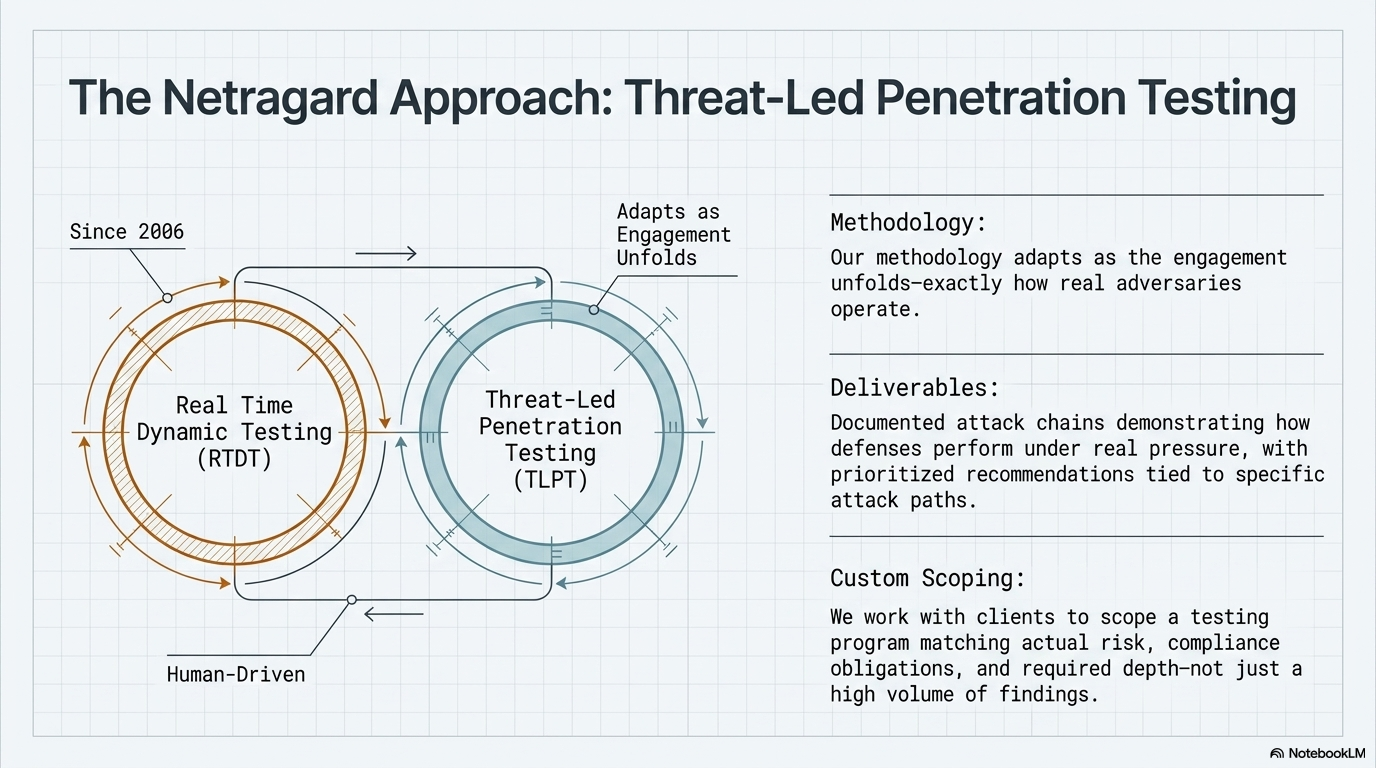
Since 2006, Netragard has delivered genuine, human-driven penetration testing anchored in threat-led penetration testing (TLPT) and our proprietary Real Time Dynamic Testing methodology. The methodology adapts as the engagement unfolds, which is exactly how real adversaries operate. The deliverable is a documented attack chain that demonstrates how your defenses would perform under the kind of pressure a real adversary applies, along with prioritized recommendations tied to the specific attack paths that exist in your environment.
Our cadence recommendations follow the same principle. At minimum, a full-depth annual engagement. Above that baseline, the cadence depends on what you need to prove, to whom, and against which adversaries. We work with clients to scope a testing program that matches actual risk, actual compliance obligations, and the depth needed to extract real value from each engagement, not just a high volume of findings.
If you’re evaluating a cadence for your organization, the questions to ask aren’t about your vendor’s testing calendar. They’re about your environment, your adversaries, and what each test is supposed to prove. The right cadence is the one that answers those questions, performed by operators who can prove they did the work.