




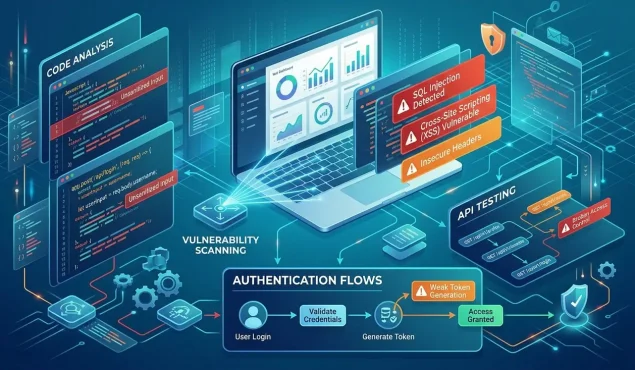
Web application penetration testing is a security assessment of your entire web application, from authentication and session management to input handling, access controls, and business logic. Experts evaluate how your application responds to malicious input, whether users can access data beyond their permissions, and how your custom workflows can be abused. The goal is to find every exploitable vulnerability, whether it is a textbook SQL injection or a business logic flaw unique to your application, before attackers do.
How Web Application Penetration Testing Works in Practice
Web application pentesting requires understanding how modern applications work: RESTful APIs, GraphQL endpoints, OAuth flows, JWT tokens, WebSockets, and the JavaScript frameworks that power single-page applications. Testers must think like developers to find flaws in your code, and think like attackers to chain those flaws into compromises. This demands expertise in application architecture, not just security scanning.
The most overlooked vulnerabilities tend to live in your business logic, your custom authentication flows, and the assumptions your developers made about how users would interact with your application. These are the flaws that automated scanners consistently miss, and they can be just as devastating as a textbook injection or a critical component vulnerability.
The goal is not simply to identify potential weaknesses, but to demonstrate actual exploitability and map the Path to Compromise: the chain of vulnerabilities an attacker would use to move from initial access to your most sensitive data (yes these exist in web applications too). This is a critical component of contextualized threat intelligence that enables you to build defenses informed by real attack scenarios rather than theoretical risk scores.
Testing must be conducted from both authenticated and unauthenticated perspectives.
- Authenticated testing evaluates what a malicious user or compromised account could achieve.
- Unauthenticated testing reveals what attackers can accomplish without credentials, including authentication bypass and unauthorized data access.
Why Web Application Pen Testing is Important
Your web applications are the front door to your organization. Customer portals, payment systems, administrative interfaces, and APIs all process sensitive data and critical transactions. In 2024, web application attacks were involved in 26% of all breaches, with the average breach costing $4.88 million.
A genuine web application penetration test costs a fraction of that exposure. If a test prevents even a single breach, the return can easily exceed 10,000%. Beyond the financial calculus, testing reveals whether your security investments actually work. Your WAF rules, input validation, session management, and access controls are only effective if they stop real attacks. Real testing provides real evidence, not assumptions.
Automated scanners and AI identify some known vulnerabilities, but they cannot understand your application. They regularly miss the IDOR that exposes customer records through predictable API parameters. They miss the race condition in your checkout flow that allows double-spending. They miss the JWT implementation flaw that lets attackers forge tokens. They miss the GraphQL query that returns data the user should never see. These application-specific vulnerabilities are precisely what sophisticated attackers hunt for, and precisely what genuine web application penetration testing finds.
The Difference Between Web App and Network Penetration Testing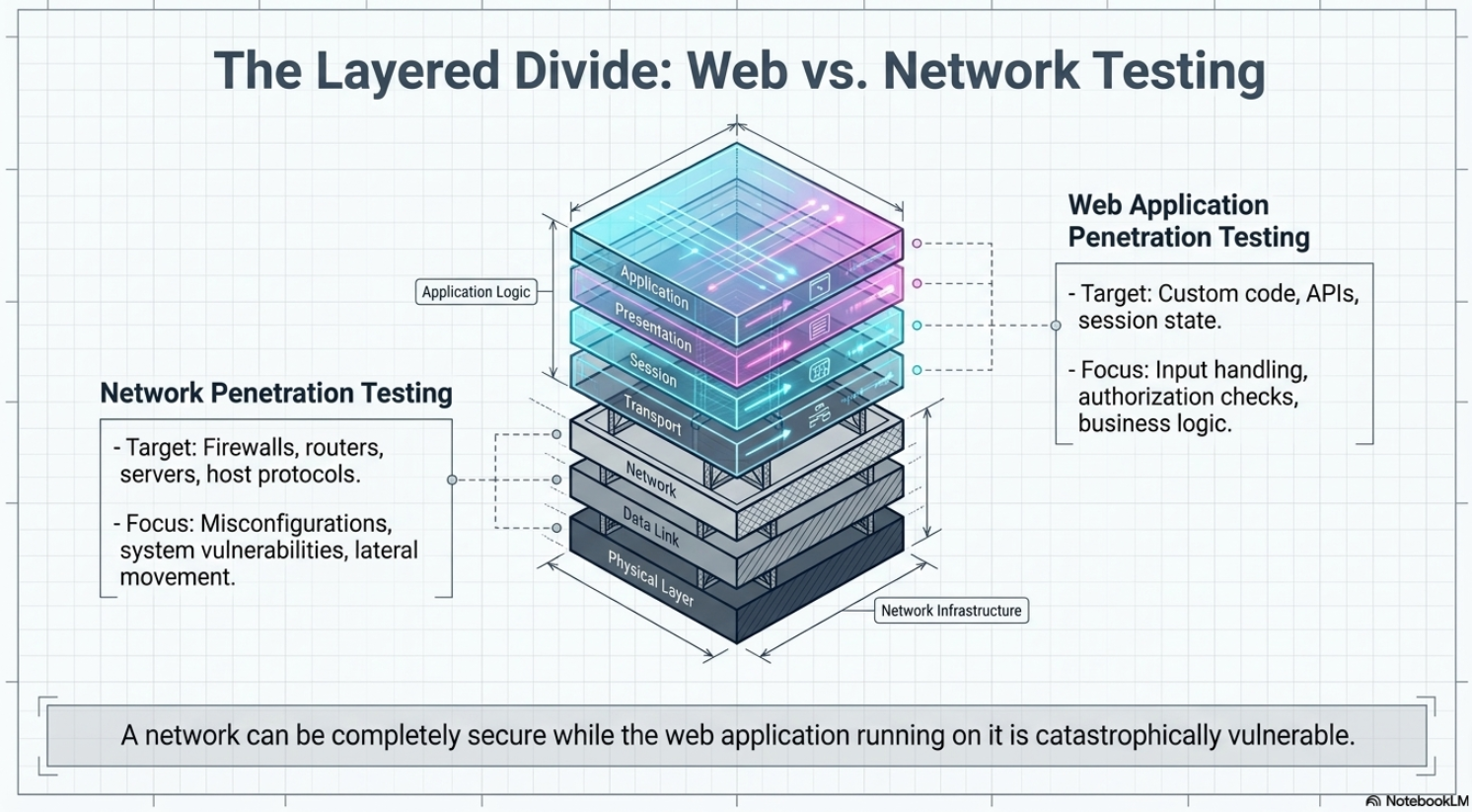
Network penetration testing evaluates infrastructure: firewalls, routers, servers, and the protocols connecting them. It focuses on network-level misconfigurations, system vulnerabilities, and lateral movement between hosts.
Web application penetration testing focuses on the application layer: how your code handles input, enforces authorization, manages state, and implements business logic. A network can be completely secure while the web application running on it is catastrophically vulnerable. A comprehensive security program requires both. For a complete overview, see our guide on types of penetration testing.
When to Perform Web App Penetration Testing
Web application penetration testing should occur:
- Before initial production deployment
- After significant code changes or new feature releases
- When integrating new third-party APIs or services
- After infrastructure changes affecting the application
- At least annually for compliance (PCI DSS, SOC 2, HIPAA)
- Following security incidents or suspected compromise
Organizations practicing DevSecOps integrate security testing into CI/CD pipelines, combining automated SAST/DAST scanning with periodic manual penetration testing for comprehensive coverage.
The Benefits of Web Application Penetration Testing
Protecting Sensitive Customer Data
Web applications serve as the primary interface to customer data. Penetration testing identifies vulnerabilities that could expose personal information, payment details, or healthcare records before attackers find them. Discovering these flaws proactively prevents breaches, regulatory fines, and the reputational damage that follows public disclosure.
Assurance for Cloud and Serverless Architectures
Modern applications run on AWS, Azure, GCP, and serverless platforms. Hosting your application in the cloud does not make it secure. Under the Shared Responsibility Model, cloud providers secure their infrastructure, but you are responsible for securing your application and its configuration. Web application penetration testing validates your application’s security regardless of where it runs, and may uncover vulnerabilities that expose underlying cloud resources. However, a comprehensive cloud security posture, including IAM policies, storage permissions, and serverless function configurations, requires a cloud configuration security assessment which is beyond the scope of application-level testing alone.
Prevent Application Downtime
Application vulnerabilities can enable denial-of-service attacks or complete system compromise. Testing identifies weaknesses that could cause outages, allowing remediation before attackers exploit them. The cost of planned testing is a fraction of unplanned downtime and incident response.
How is a Web App Penetration Test Performed?
Scoping and App Discovery
Engagement begins with defining the testing scope: which applications, environments, and functionality are in scope. Discovery identifies the application’s technology stack, frameworks, endpoints, and integrations. Scope determines cost, and cost is based on measured workload, not arbitrary metrics like page count. Vendors who price based on page count will deliver superficial coverage at best.
Application Mapping
Testers map the application’s structure: pages, forms, APIs, parameters, and workflows. This phase identifies the attack surface and informs the testing strategy. Mapping reveals hidden functionality, administrative interfaces, and forgotten endpoints that often lack security controls.
Vulnerability Identification and Validation
Testers probe the application for vulnerabilities using manual techniques and specialized tools. Genuine testing goes beyond OWASP Top 10 coverage to identify business logic flaws, complex attack chains, and vulnerabilities unique to your application. This is where human expertise matters most. Scanners and AI find known patterns; skilled testers find what automation cannot.
Exploitation and Impact Analysis
Discovered vulnerabilities are exploited to confirm existence and demonstrate business impact. This phase shows what an attacker could actually achieve: accessing sensitive data, manipulating transactions, escalating privileges, or compromising backend systems. Exploitation eliminates false positives and provides concrete evidence of risk. This is what separates penetration testing from vulnerability testing.
Reporting, Remediation, and Retesting
Comprehensive reports document each vulnerability with reproduction steps, risk ratings, and remediation guidance. Quality reports provide contextualized threat intelligence specific to your application, not generic vulnerability descriptions. Retesting within 60 to 90 days verifies fixes and ensures no new vulnerabilities were introduced during remediation.
Common Web App Vulnerabilities Tested
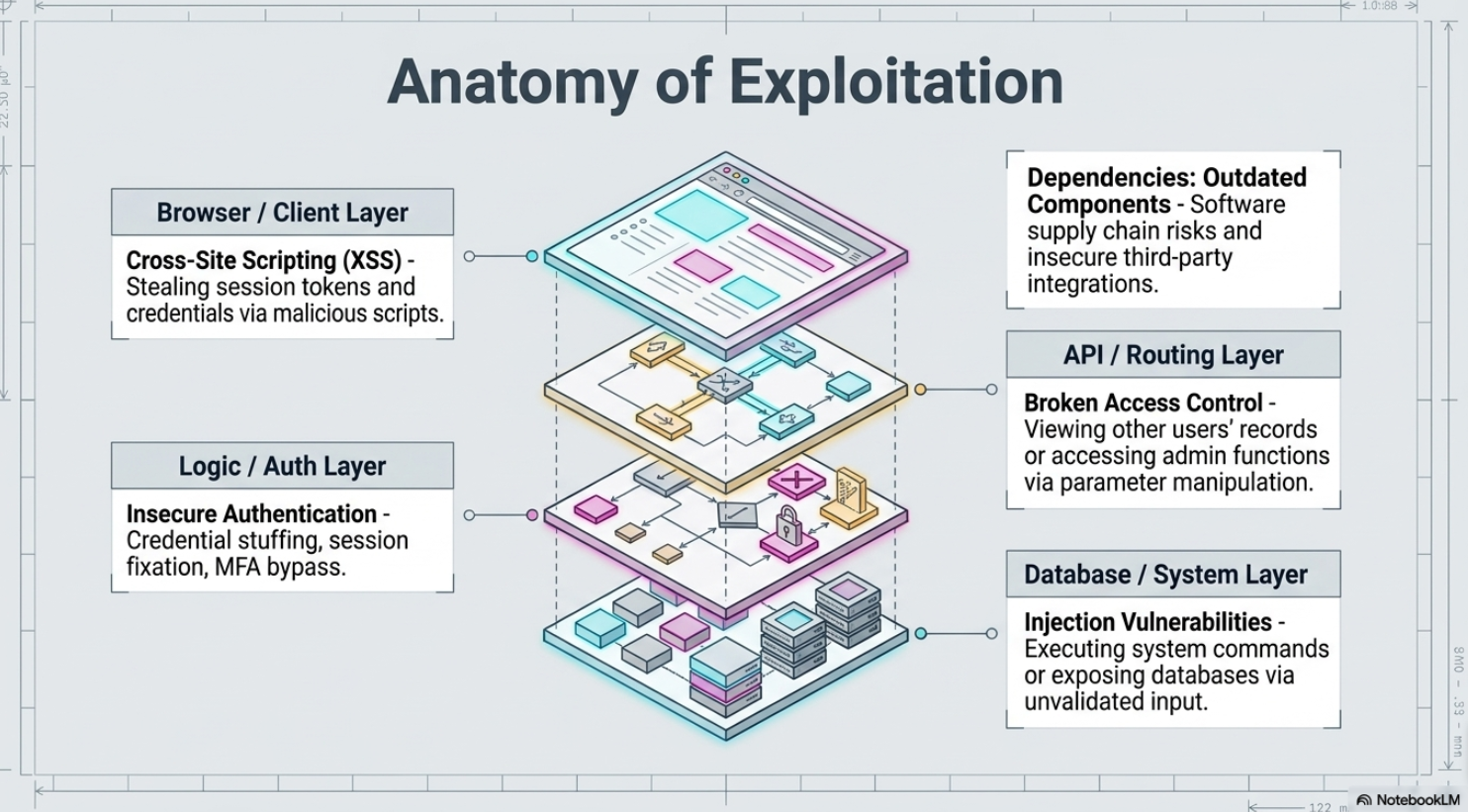 Broken Access Control
The number one vulnerability in the OWASP Top 10. Testing evaluates whether users can access data or functionality beyond their authorized permissions: viewing other users’ records, modifying data they should only read, or accessing administrative functions through parameter manipulation.
Injection Vulnerabilities
SQL injection, command injection, LDAP injection, and other injection attacks occur when user input is processed without proper validation. Testers probe every input field, parameter, and header for injection opportunities that could expose databases or execute system commands.
Insecure Authentication
Testing evaluates login mechanisms, password policies, session management, and multi-factor authentication implementation. Weaknesses include credential stuffing vulnerabilities, session fixation, insecure password reset flows, and MFA bypass techniques.
Outdated Components and Integrations
Modern applications rely on frameworks, libraries, and third-party integrations. Testing identifies vulnerable components, insecure API integrations, and software supply chain risks. A single outdated library can introduce critical vulnerabilities into an otherwise secure application.
Cross-Site Scripting
XSS vulnerabilities allow attackers to inject malicious scripts that execute in users’ browsers. Testing identifies reflected, stored, and DOM-based XSS that could steal session tokens, capture credentials, or redirect users to malicious sites.
Core Methodologies and Frameworks
The OWASP Top-10
The Open Web Application Security Project (OWASP) Top 10 is the industry standard for web application security risks. The list identifies the most critical vulnerabilities based on prevalence and impact, including Broken Access Control, Injection, Cryptographic Failures, and Security Misconfiguration. Genuine penetration testing covers the OWASP Top 10 as a baseline but goes further to identify vulnerabilities specific to your application’s business logic.
NIST SP 800-115
The National Institute of Standards and Technology’s Technical Guide to Information Security Testing provides a framework for planning, conducting, and reporting security assessments. It establishes standards for testing methodology, documentation, and risk assessment that align with federal compliance requirements.
Manual vs Automated Web App Penetration Testing
This distinction determines whether you receive genuine security insight or expensive checkbox compliance.
Automated DAST (Dynamic Application Security Testing) tools identify some known vulnerability patterns quickly and consistently. They excel at finding SQL injection, XSS, and missing security headers across large applications. They cannot think creatively, chain vulnerabilities, or discover novel attack paths.
Manual testing discovers what automation cannot: business logic flaws, complex authentication bypasses, and multi-step attack chains. A scanner cannot understand that a discount code accepting negative values allows free products, or that a workflow permits transferring funds from accounts the user does not own. These are the vulnerabilities that matter most.
Genuine web application penetration testing combines both approaches. Scanners provide efficiency and consistent baseline coverage. Human testers provide depth, creativity, and the ability to discover vulnerabilities that exist only in your specific application’s logic.