




How to tell whether your last penetration test was adversary emulation or compliance theater.
Most organizations buy penetration testing without really knowing how to evaluate the quality of work reflected in the resulting reports. The industry knows this and is saturated with vendors who produce reports that look like penetration tests, read like penetration tests, and arrive with the same polished cover page that a buyer would expect, but were produced by automated tools, some with superficial human review, and some with none.
This article walks through five penetration testing basics every buyer should understand. The framing is intentional. These aren’t academic descriptions of penetration testing methodology. They’re practical signals you can use to judge the quality of the work you paid for. Where appropriate, the article includes specific tests you can run on your own report to determine whether the work was the result of human operators or automation.
The single most important framing is that quality matters far more than the volume of findings or the speed of delivery. A report with 200 vulnerabilities is less useful than a report with 12 findings that can cause operational or business impact. Addressing 200 generic findings consumes resources without meaningfully improving your defenses. Acting on 12 findings tied to your specific environment, business context, and adversary capabilities advances your posture and prevents damage. In cybersecurity, volume doesn’t represent value. It comes at value’s expense.
Why How You Test Matters More Than the Result
Two penetration tests can both pass and only one can save you. The difference is the conditions you tested under.
At its core, penetration testing answers one question: can something get in, and how far through? How you test that question matters more than the answer. Pressure test a submarine in a swimming pool and it can pass. Pressure test a second submarine at three thousand feet, under real conditions, and it can also pass. Both passed a penetration test. Which one are you climbing into?
A real penetration test produces results that help you survive contact with an adversary. Automated and AI driven tests produce results that help you survive an auditor. Which kind you received determines whether your hull actually holds when you go deep, or if it’ll implode. The worst outcome is the one you can’t see coming. You trust the report your vendor sold you, you dive, and the hull gives way at depth because the test was never realistic. Almost every breached organization believed exactly what you believe right now because they were sold a false sense of security.
The most famous example of this came out of the Target breach from September of 2013. Testifying under oath before the Senate Committee on Commerce, Science, and Transportation on March 26, 2014, Target CFO John Mulligan stated, “And, in September 2013, our systems were certified compliant with the Payment Card Industry Data Security Standards, meaning that we met approximately 300 independent requirements of the assessment. Yet the reality is that our systems were breached.” The compliance program that satisfied every regulator on paper delivered little more than a false sense of security.
The five basics that follow are the diagnostic checks every buyer can run against any penetration test report to determine whether they bought a real test or compliance theater dressed up as one.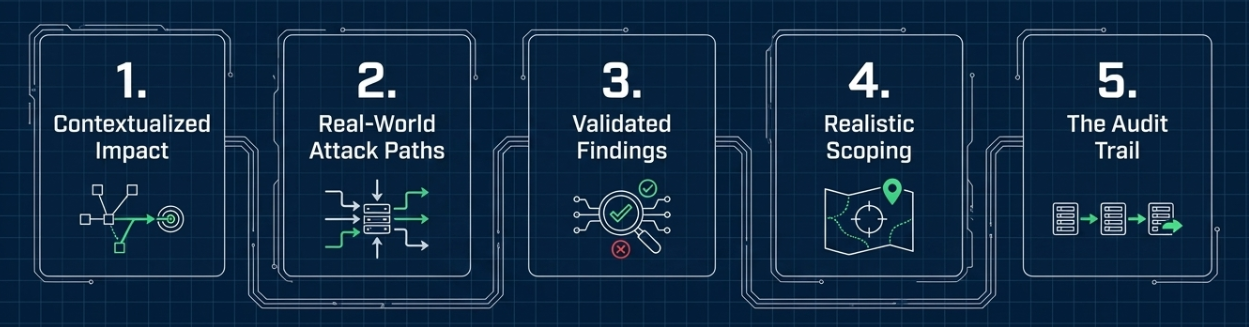
1. Identify Exploitable Vulnerabilities and Context
A real test tells you what an attacker can actually do in your environment, not just what is broken in a vendor’s signature database.
Industry standard penetration testing produces an inventory of vulnerabilities but fails to provide meaningful defensive value. Discovering vulnerabilities is only part of the job. The context around each finding is what determines whether it poses legitimate risk. That context includes how an adversary can move through your environment, how your business logic shapes available attack paths, and which assets are most attractive to the threat actors targeting you. We call that contextualized threat intelligence. It tells you not just that a vulnerability exists, but what an adversary could do with it in your specific environment. Most importantly, it tells you how to disrupt that behavior, not just patch the vulnerability.
Not every vulnerability is worth fixing. The ones that matter are the ones that move an attacker closer to their goal. If your report is an inventory of vulnerabilities with risk scores that don’t make sense to you, that’s a strong signal context wasn’t considered in the engagement. If your report instead contains findings tied to meaningful impact within the context of your organization, you likely received the real deal.
2. Emulate Real-World Attack Paths
A real test, when scope and engagement type permit, shows how an attacker chains findings through your specific environment to reach assets that matter.
Emulating (not simulating) real world attack paths, also called paths to compromise or vulnerability chaining, is another capability that requires human operators. Some vendors argue that their autonomous technology can build attack chains. It can, but the chains it builds are generic templates pulled from documented attacker playbooks, not paths discovered through reasoning about your specific environment, which is exactly what attackers will find and exploit.
The problem with templatized attack chains is that they’re written for a generic environment that resembles yours in some ways. When an environment doesn’t match the playbook, the chain breaks. When a defender intervenes, the chain breaks. When the path requires the operator to invent a step that wasn’t in the script, the chain breaks. The technology can’t improvise because it can’t comprehend the full context of the engagement. Automated chaining is superficial at best.
A real Path to Compromise is built from the environment, not against it. The operator starts with what’s exposed, learns what the environment reveals about itself, and chooses each step based on what the previous step showed.
- A low severity finding becomes the initial foothold because the operator recognized it gave them a position in a place no one was watching.
- A configuration weakness becomes the privilege escalation because the operator noticed it was inherited from a third-party tool the organization had forgotten about.
- A forgotten credential becomes the pivot because the operator went looking for it after seeing a hint in a configuration file.
- A misconfigured service becomes the path to the asset the attacker actually wanted because the operator understood the business well enough to know which asset that was.
The chain is unique to your environment because it could only have been built inside your environment by someone with full contextual awareness.
During one Netragard engagement against a well-known casino, we extracted employee information from LinkedIn, registered a doppelganger domain to impersonate the casino’s legitimate domain, used a technique called email seeding to plant our address in recipients’ auto complete caches, delivered a zero day Microsoft Word exploit through the trust relationship we had built, and within 30 minutes of initial access had more control over the casino’s network than its own IT department. None of those steps were predefined. Each one was a response to what the previous step showed us. No AI or other autonomous tool can do that, not even Mythos. That’s what a real Path to Compromise looks like, and it’s what a buyer who’s paying for adversary emulation should expect to see in a report.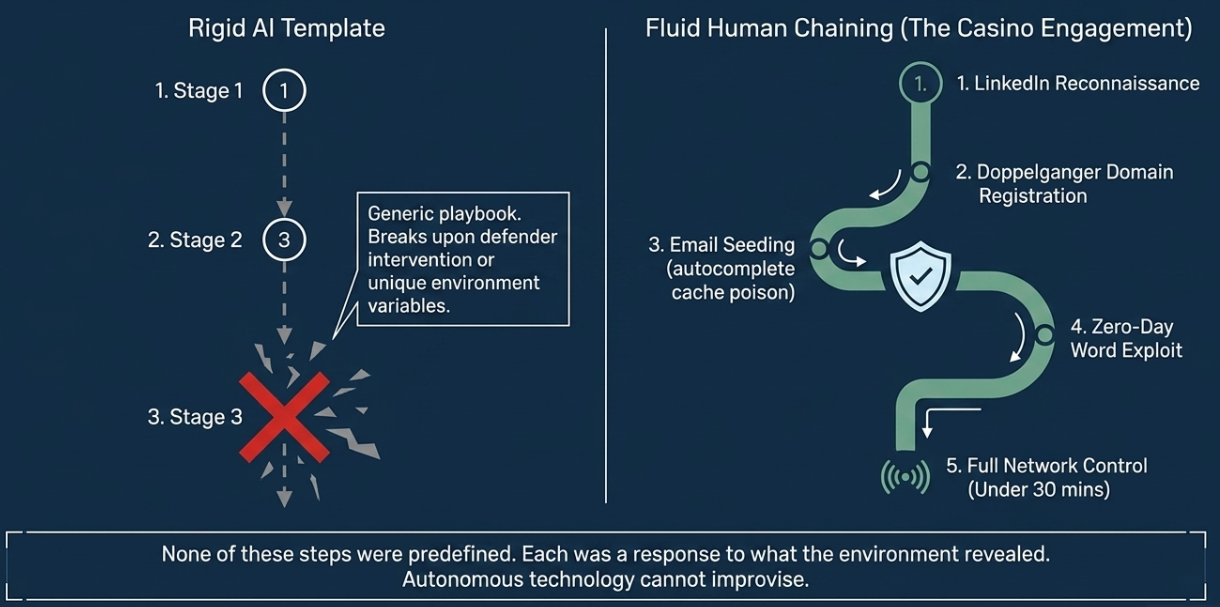
When to Expect a Path to Compromise in Your Report
Path to Compromise is the deliverable of real penetration testing, not compliance-grade scanning. The capability ties directly to engagement depth and scope. Compliance-grade testing satisfies regulators with the lowest acceptable amount of effort and does not produce a legitimate Path to Compromise. Real penetration testing, sometimes branded as adversary emulation, red teaming, or threat-led penetration testing, should produce at least one documented Path to Compromise unless scope explicitly restricted it. If you bought compliance-grade testing, the absence of a P2C in your report is a function of scope, not a quality issue. If you bought real penetration testing and your report does not contain one, the work was scoped to discover, not to test, or you did not buy a real test.
When you read your report, if it contains a chain, test the chain. A documented Path to Compromise should be a narrative that starts at a specific entry point, moves through specific findings in a specific order, and reaches a specific objective that mattered to your business. If your report contains a chain that is not unique to your environment or that reads like a generic playbook with your company name swapped in, the work was scoped to discover, not to test. That’s a compliance penetration test, not a genuine penetration test.
3. Provide Validated and Actionable Findings
A real test proves every finding with evidence and writes remediation that fits your stack, not generic boilerplate.
A validated finding is one that has been confirmed in your environment, not generically. An actionable finding includes remediation that fits your specific stack and operational realities. When automation is used, both the validation language and the remediation language tend to be generic. The value to you tends to be generic too.
The false positive rate is another tell. Experienced human testers deliver near zero false positives. When a human tester writes a finding, it’s because they exploited a vulnerability and collected evidence, or made an observation and collected evidence. Reporting on something they didn’t observe or successfully exploit would require fabricating the finding outright. Most testers wouldn’t do that.
Automated scanners and AI produce false positives in high volume. Scanners produce them when their signature databases incorrectly match a network probe result. AI produces them the same way, but it can also hallucinate findings outright. When a human reviewer drops automated output into a report without verifying it, the false positives go in with everything else. That’s how most penetration testing reports come to contain them. If you find a reported issue that doesn’t seem to apply to your environment, that’s probably where it came from.
A Quick Test You Can Run on the Report
There’s a simple test you can run on the report’s language directly. Skip the title and heading of each finding. Many seasoned penetration testers use the title and heading conventions from tools like Nessus or other scanners as a starting point and then write the body of the finding themselves. A search on the title alone tells you nothing useful. Instead, take the complete text of the body of a finding, the description, risk statement, and remediation, and strip out the parts that are unique to your environment, such as IP addresses, hostnames, application names, account names, and references to your specific business processes. Put what remains into Google inside quotation marks and search. If the result returns hits from other vendor reports, scanner documentation, or template libraries, the body of the finding was copied or generated, not written for you. Real human writing should be unique to the engagement. Even when human operators reuse phrasing across reports, the language around your specific environment should make most sentences unsearchable.
4. Match Scope to Real-World Adversaries
A real test is scoped around how an attacker would target your environment, not around what is easy to scan against a checklist.
The primary objective of a genuine penetration test is to strengthen your overall security posture, with regulatory compliance being a natural byproduct of realistic testing. Defining the scope of the engagement is critical to delivering meaningful value. When testing web applications, organizations often exclude the backend environments, which can create a dangerous blind spot. In these cases, the application itself may appear secure, but attackers can simply compromise the underlying environment to obtain the same data. Make sure your scope encompasses the full boundary of what you’re trying to protect.
The clearest signal a provider takes this seriously is whether they ask the right questions before providing a quote, let alone signing it. Who owns each asset? Who needs to be informed when something is found? Who decides on scope changes during the engagement? A provider that asks those questions is treating the work as adversary emulation. A provider that doesn’t is treating it as a transaction. Without that alignment, the test ends with findings that no one is expecting to receive, and that isn’t always a good surprise.
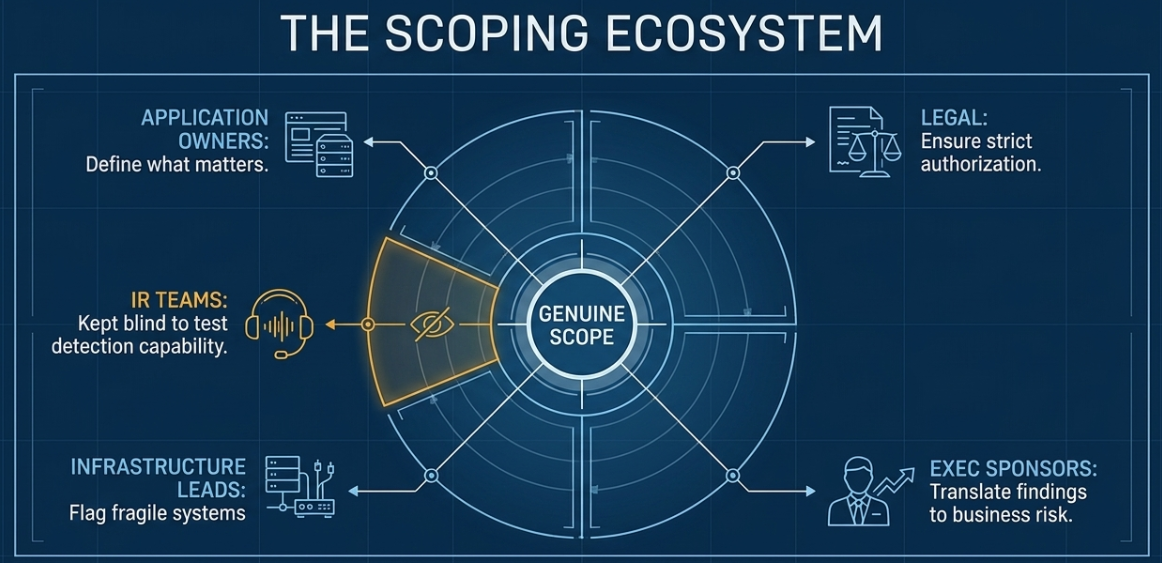
Penetration testing isn’t an exclusive security team project. It’s an organizational project with a wide reach. A serious engagement involves multiple stakeholders, each contributing different information and managing different concerns.
- Application owners need to know what’s being tested in their systems and should help define scope, so the test focuses on what matters.
- Infrastructure leads need to know what may be touched and should flag fragile or business critical systems before testing starts.
- Incident response teams are often intentionally kept uninformed so the engagement also tests their detection and response capability under realistic conditions. In those cases, a small control group needs to know how to distinguish an active test from an active breach.
- Legal needs the authorization in place.
- The executive sponsor needs to know what could surface and what it would mean for the business.
Black Box, White Box, and Gray Box Testing
Scope conversations also include how much information the testing team starts with. Black Box testing is “let’s see what we can find in the time you give us.” The tester starts with the same information an external attacker would have, discovers targets, maps the infrastructure or application, identifies potential points, then launches their attack. The format sounds realistic because it mirrors how an external adversary works, but it isn’t. A real adversary isn’t time restricted and can spend weeks or months performing reconnaissance before they ever reach out and touch a target. A Black Box test compresses all of that into the engagement window, creating real restrictions. The tester has to do the attacker’s homework and the exploitation work in a fraction of the time an attacker has. The result is much less coverage than the same engagement would produce under a different model.
White Box testing, which can also be run as a variant of Purple Teaming, solves that problem. The buyer hands the testing team architectural information, source code, credentials, and whatever else the testers need. That puts the team at the same starting position a determined attacker would reach after weeks or months of reconnaissance, often a better one. With that head start, the entire engagement window goes to coverage and depth rather than catching up.
A White Box engagement typically reveals more, and reveals it earlier, than a Black Box test of the same scope and duration. Gray Box sits between the two with the customer providing some context but not full detail. It emulates an attacker who has gained partial knowledge through reconnaissance or insider compromise. It’s the right choice when the question is specifically about what happens after an attacker gets one foot in the door.
Regardless of which model you choose, you’ll need to give the penetration testing company specific scope details.
- IP addresses and network ranges
- Application URLs, a live demo of any application being tested, and accounts to use
- The rules of engagement.
The more accurate the scoping conversation, the more accurate the proposal you’ll receive, the more value you’ll get for your spend.
If the question is “can my defenses survive a real attack,” White Box gives you the most useful answer within the time and budget you have. A provider who recommends an approach without first understanding your exact needs is a provider to avoid.
5. Produce a Documented Audit Trail
A real test leaves behind proof of human work performed under authorized, ethical, and lawful boundaries.
The ethical and legal scaffolding around penetration testing is also where buyers can read a lot about the quality of the work being done. Real operators work under tight Master Service Agreements with strict liability requirements. Penetration testing isn’t a normal service, and legitimate testing can cause outages. For this reason, seasoned penetration testing companies will accept liability for things like gross negligence or willful misconduct and not much else. We have a detailed writeup on pentest liability here.
Consent and Authorization
Real penetration testing requires written authorization that clearly defines scope, timing, escalation paths, and rules of engagement. Cloud providers, hosting companies, and third-party services that touch your environment may also require advance notice. A provider that takes consent and authorization seriously documents this rigorously. A provider that doesn’t is creating legal exposure for you and themselves. This is one of the key reasons behind providing your IP addresses and URLs to a penetration testing company before receiving a quote.
Legal Boundaries
Penetration testing operates inside narrow legal boundaries. Activities that look identical to a real attack are legal because of the authorization granted by the client. The boundary is exact. Testing systems that weren’t authorized, exfiltrating data that wasn’t in scope, or persisting access beyond the engagement window all cross from authorized testing into criminal activity. A real penetration tester respects these boundaries strictly. Their reports document what was attempted, what was achieved, and what was specifically declined or left out of scope. The presence of that documentation is itself a quality signal.
The Audit Trail
The relevant point for buyers is that ethical operators document everything. A real penetration test report includes an audit trail of operator activity that can be reconciled against your own log files. Automated tools produce output. Human ethical operators produce output plus the documentation that proves the output was generated lawfully and intentionally. Ask your provider for the audit trail. The presence of one is a strong signal of human work. The absence of one is a signal that the report should be examined against the other tests in this article.
What Penetration Testing Can’t Do
Knowing the limits of penetration testing keeps you from buying it as a substitute for capabilities it was never designed to provide.
Guarantee Safety From Breaches
Breach prevention isn’t a realistic goal. Determined adversaries with sufficient time, resources, and motivation will eventually find a way in, regardless of how much you spend on defenses. Damage prevention is realistic, and realistic penetration testing is how you achieve it. A real test produces the intelligence you need to facilitate early, effective detection and response, and to limit what an adversary can do once inside. The objective isn’t to make sure no one ever gets in. The objective is to make sure that when they do, the damage is bounded.
Act as a One-Time Fix
A penetration test is a measurement, not a remediation. The work of fixing what was found, validating that the fix actually closes the discovered issue, and adjusting your detection and response posture in light of the findings is your responsibility. It doesn’t happen because you commissioned a test. Treating the report like a deliverable, archiving it, and moving on is to pay for something without actually using it. The value of a real penetration test is realized by using the intelligence it provides to advance your overall security posture. If the report doesn’t enable you to do that, you probably didn’t get a genuine test.
Solely Ensure Compliance
Most penetration testing vendors today exist because compliance frameworks like PCI DSS, HIPAA, and others require testing. Those requirements created a market for testing that satisfies the regulator with the lowest acceptable amount of effort. Compliance penetration testing and real penetration testing aren’t the same thing. Compliance is the swimming pool test from earlier. It documents that testing occurred. It doesn’t validate whether your defenses can withstand a real adversary. Real penetration testing is the test at three thousand feet under real conditions. It validates your defenses against actual threats, and produces the contextualized threat intelligence to make them stronger.
If you focus on lowest cost or treat penetration testing as a compliance checkbox, the breach that follows will cost you far more than a real test would have.
How Often Should You Test
Annual depth beats quarterly noise, and most continuous testing offerings are not what most buyers think they are buying.
Most frameworks recommend penetration testing annually at minimum, and after any significant change. Significant changes include:
- Major application releases
- Infrastructure migrations
- Mergers and acquisitions
- Organizational restructuring
Vulnerability scanning, PTaaS, or AI based penetration testing operate on a different cadence, typically monthly or quarterly, because they’re appropriate for ongoing maintenance. These services aren’t the same as genuine penetration tests but do compete with compliance focused testing.
The frequency answer most buyers should hear, however, is this. A single high-quality test annually produces more security value than four shallow tests quarterly. The shallow tests will produce more findings on paper, but the deep test will produce findings that map to real value. That value compounds across the testing window whereas volume doesn’t.
If your provider is selling continuous testing or quarterly testing as a substitute for adversary emulation, ask what the actual depth of each test is. Continuous offerings involve automated scanning or AI, with periodic manual review. That has its place, but it isn’t what most buyers are paying for when they think they’re buying an actual penetration test.
Netragard’s Approach to Penetration Testing
Threat-led penetration testing is the framework that makes the right answer to each of the five basics the default rather than the exception.
Since 2006, Netragard has delivered genuine, human driven penetration testing that goes far beyond automated scanning. Our work is anchored in threat led penetration testing, also known as TLPT. The premise is that meaningful security validation comes from testing your environment the way an actual adversary would attack it, given your industry, your threat profile, and your specific exposure. The methodology and deliverable are organized around that idea, not around the volume of findings or the speed of the report.
Threat led penetration testing differs from compliance penetration testing in scope, methodology, and deliverable. The scope is built around realistic threat actor objectives rather than checkbox coverage. The methodology emphasizes adversary emulation over vulnerability enumeration. The deliverable is a documented attack chain that demonstrates how your defenses would actually perform under the kind of pressure a real adversary applies, along with prioritized recommendations tied to the specific attack paths that exist in your environment.
Genuine penetration testing of this kind requires experienced and creative human operators. It leverages the kind of creativity and intuition that can’t be replicated by technology, not even by AI.
Our proprietary methodology is called Real Time Dynamic Testing. It adapts as the engagement unfolds, which is exactly how real adversaries operate. Rather than following a predetermined script, our operators adjust tactics based on what they discover in your environment. The result is a test that finds the business logic flaws, complex attack chains, and environment specific vulnerabilities that automated tools miss entirely.
If you’re evaluating a penetration testing provider against the five pen testing basics in this article, threat led penetration testing is the framework that makes the right answer to each of them the default rather than the exception.
- Quality over quantity
- Exploitation over identification
- Chained reasoning over flat lists
- Environmental specificity over generic findings
- Documented integrity over polished output.
The right test is the one that measures what an actual adversary would do against you, performed by operators who can prove they did the work. Everything else is reporting.