



Key Takeaways:
- Penetration testing and vulnerability scanning differ fundamentally: Vulnerability scanning uses automated tools to quickly identify known issues, while penetration testing uses manual expertise to exploit vulnerabilities and demonstrate real-world attack scenarios, providing deeper security assessment.
- Vulnerability scanners are limited and reactive: Automated scans miss complex, undisclosed, or contextual vulnerabilities, produce false positives/negatives, and always lag behind real-time threats due to reliance on publicly updated vulnerability databases.
- Threat-led penetration testing delivers superior value: Expert-driven penetration testing uncovers deeper issues, validates exploitability, provides business context, and offers tailored remediation that automated tools and compliance checklists cannot match.
- Both methods are complementary, not competitive: Organizations should use vulnerability scanning for routine checks and broad coverage and reserve penetration testing for in-depth, contextual risk validation and critical business changes.
- Regular human-led penetration testing is essential for actual security: Automated tools alone cannot keep pace with evolving attack methods and do not replicate sophisticated adversarial tactics; genuine penetration testing should be performed at least annually or upon major changes for strong security posture.
When it comes to cybersecurity assessments, organizations often find themselves choosing between penetration testing and vulnerability testing. While both approaches aim to identify security weaknesses, they differ significantly in scope, methodology, and outcomes. Understanding these differences is crucial for selecting the right assessment type for your organization’s security needs.
Penetration Testing vs Vulnerability Scanning – Differences Explained
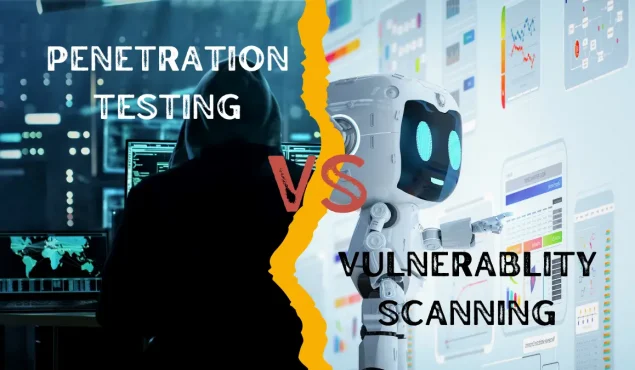
The fundamental difference between penetration testing and vulnerability scanning lies in their approach and depth. While vulnerability scanning identifies potential security weaknesses through automated tools, penetration testing goes beyond detection to actively exploit vulnerabilities and demonstrate real-world attack scenarios. This distinction makes penetration testing a more comprehensive, though resource-intensive, security assessment method.
What is Vulnerability Scanning (aka Vulnerability Testing)?
Vulnerability Scanning, commonly referred to as vulnerability testing, is an automated process that uses specialized software to identify publicly known security vulnerabilities in systems, applications, and network infrastructure. These scans compare system configurations and software versions against databases of known vulnerabilities, producing reports that highlight potential security issues.
Key characteristics of vulnerability scanning include:
- Automated scanning using commercial or open-source tools
- Rapid identification of known vulnerabilities across large networks
- Regular scheduling capability for continuous monitoring
- Cost-effective approach for baseline security assessment
- Limited to identifying surface-level vulnerabilities
How Vulnerability Scanners Work
Vulnerability scanners operate through a systematic process:
- Discovery Phase: Using known methods, scanners probe networks to discover systems, open ports, software, applications, networking hardware, etc.
- Enumeration: Detailed information about each service is gathered, including version numbers and configurations.
- Vulnerability Detection: The scanner compares findings against its database of known vulnerabilities (CVE, vendor advisories).
- Reporting: Results are compiled into reports showing vulnerability severity (generic with no context), affected systems, and generic remediation suggestions.
Automated scanning offers fast coverage of a broad scope, but it lacks thoroughness, context, and creativity. On a good day, a scanner might identify 60% of the vulnerabilities that actually exist. However, because scanners depend on signatures and predictable patterns, they generate false positives and fail to discover complex vulnerabilities. No automated tools (including AI Penetration Testing tools) can replicate the critical thinking, adaptability, or real-world techniques, tactics and procedures of real threat actors and seasoned penetration testing experts.
What is Penetration Testing?
A penetration test identifies ways in which an attacker (or malware) can gain unauthorized access to, or move laterally through, an infrastructure or system. In the context of IT security, penetration testing vs vulnerability testing evaluates an organization’s ability to withstand real-world attacks by emulating the tactics, techniques, and procedures used by threat actors. Its purpose is to assess the effectiveness of security controls, uncover exploitable weaknesses before adversaries do.
There are two types of penetration testing companies: those that focus on compliance, and those that focus on security. Compliance-driven penetration testing is typically less expensive but delivers little to no meaningful security value. Its primary goal is to meet the minimum requirements needed for regulatory or contractual obligations, allowing organizations to “check the box” and continue operations. In the long-term compliance penetration testing has a negative return on investment (ROI) equal to the cost in damages of a single successful compromise (in 2024 the cost per incident was $4.8 million).
In contrast, genuine penetration testing, which we refer to as Threat-Led Penetration Testing (TLPT), is designed to improve defenses by delivering actionable, contextual threat intelligence, the kind required to build effective threat-informed security programs. Rather than treating compliance as the objective, TLPT prioritizes actual security, with compliance becoming a natural outcome of a rigorous, intelligence-driven engagement.
Moreover, the ROI for a typical $40,000 TLPT engagement is approximately 12,000%, based on the cost savings associated with breach prevention, downtime reduction, and early detection of critical vulnerabilities.
The Temporal Gap: Why Vulnerability Scanners Always Lag Behind
The Temporal Gap refers to the time between when a vulnerability is first discovered and when automated vulnerability scanners are updated to detect it. When a novel vulnerability is initially found, it is known only to the researcher (or threat actor) who discovered it. During this window, organizations have zero days to respond or establish defenses before the vulnerability can be exploited, hence the origin of the term “zero-day”.
Initial Discovery: Vendor notification and the race against time
When security researchers discover a vulnerability, they typically follow responsible disclosure practices by notifying the affected vendor. This initiates a critical timeline where the vendor must develop, test, and release a patch while the vulnerability remains unknown to the public. During this period, which can last weeks or months, organizations using vulnerability testing and penetration testing tools won’t detect the issue through automated scans.
The exploitation window: From discovery to patch release
Once a zero-day is discovered, the clock starts ticking. The period from initial discovery to the release of an official fix is often referred to as “n-days”, where n is the number of days the vulnerability has existed without a patch. Organizations must understand this critical window when evaluating the difference between penetration testing and vulnerability testing, as only human-led penetration testing can potentially identify these undisclosed vulnerabilities.
Scanner database updates: Always playing catch-up
What makes this especially risky is that automated scanners can’t detect these vulnerabilities until they’ve been publicly disclosed and added to scanning engines, which may take months or even years. If the vulnerability is sold through private brokers instead of disclosed, it might never become known.
This delay highlights a critical limitation of automated scanning: it is inherently reactive and will always lag behind the capabilities of real-world threat actors. In contrast, threat-led penetration testing offers deeper and more meaningful coverage. While it may not uncover every undisclosed vulnerability, it will deliver the contextualized threat intelligence that enables organizations to build effective, threat-informed defenses, the kind that can disrupt attack paths accessed by 0-day exploitation before real damage occurs.
Vulnerability scanners face an inherent temporal disadvantage in the cybersecurity landscape. By design, they can only detect vulnerabilities after they’ve been discovered, documented, and added to vulnerability databases. This creates a dangerous window of exposure that is often accompanied by a false sense of security.
Why False Positives and Negatives Happen
A false positive occurs when a vulnerability that doesn’t actually exist is mistakenly reported as real. A false negative, on the other hand, is when a real vulnerability exists but is missed and excluded from the report.
False positives waste valuable time and resources, taking attention away from other real, potentially high-risk issues, extending the opportunity for exploitation. False negatives are even more dangerous because they leave real vulnerabilities unaddressed, increasing the likelihood that they will be discovered and exploited by threat actors to affect a silent breach.
Main causes of false positives and false negatives:
- Inaccurate Detection Algorithms: Many scanning and testing tools use overly broad or poorly tuned detection rules, causing legitimate configurations or behaviors to be misidentified as vulnerabilities.
- Lack of Context: Automated tools cannot understand business logic, intended behavior, or the operational context of the system, leading to harmless activity or safe configurations being flagged as threats.
- Misconfigured Security Tools: If vulnerability scanners are wrongly configured, they can generate excessive or incorrect alerts, incorrectly flagging benign responses as vulnerabilities.
- Outdated Vulnerability Signatures or Intelligence Feeds: When tools rely on old or deprecated threat intelligence or vulnerability databases, they can misapply findings and flag vulnerabilities from one ecosystem against unrelated software packages.
- Complex or Hybrid Environments: Modern systems often span cloud, on-premises, and hybrid architectures which makes automated analysis error-prone and less reliable, especially when environmental differences aren’t accounted for.
- Anomaly-Based Detection Limitations: Behavioral or anomaly-based systems may misinterpret rare but legitimate actions as malicious simply because they are unusual, not necessarily unsafe.
- Security Controls That Mimic Attacks: Some protective mechanisms (like intrusion detection/prevention systems and web application firewalls) can produce behavior that triggers false alerts in testing tools.
- Over-reliance on Automatic or Single Method Detection: Relying only on one form of detection increases the risk of both false positives and false negatives, overwhelming analysts with noise.
- Cross-Ecosystem Confusion: Scanners often misapply vulnerabilities across ecosystems, such as between similarly named packages in different programming languages, resulting in incorrect findings.
- Insufficient Tool Updates or Poor Understanding of Application Frameworks: Scan tools not updated for new frameworks, lacking specific knowledge about custom or less common technologies, or missing the latest signatures often generate spurious findings.
Threat Led Penetration Testing almost entirely eliminates false positives and significantly reduces false negatives through human expertise, creativity, and experience.
Penetration vs Vulnerability Testing Side-by-Side Comparison Table
The following comparison highlights key differences between these two security assessment approaches:
| Aspect | Vulnerability Testing | Penetration Testing |
|---|---|---|
| Methodology | Automated scanning | Manual + automated |
| Depth | Superficial | Comprehensive |
| False Positives | High | Near Zero |
| Business Context | Minimal to None | Comprehensive |
| Cost | Lower | Higher |
| Time Required | Hours to days | Days to weeks |
| Skill Required | IT Administrator or Analyst | Offensive Security Expert |
Common Detection Methods
The differences between TLPT and Automated Vulnerability Scanners detection methods is notable.
Automated Vulnerability Scanners
- Pattern matching and signature-based detection restricted to known vulnerabilities
- Version fingerprinting
Threat Led Penetration Testing
- Human expertise, adaptability, and creativity to discover both known and novel vulnerabilities as well as known and novel methods of exploitation.
- Context-aware vulnerability discovery and exploitation to not only detect vulnerabilities but clearly articulate business impact.
- Provides coverage for known Techniques, Tactics and Procedures (TTPs) used by modern threat actors as well as novel TTPs unique to your environment.
- Discovers vulnerabilities related to human behavior and uncovers the behaviors required to facilitate a breach.
- May use Automated Vulnerability Scanning to check complete coverage for low-hanging-fruit.
What Genuine Penetration Testing Adds
Automated Vulnerability Scanning, Compliance Penetration Testing, and Genuine Penetration Testing (Threat Led Penetration Testing) are not created equal. Genuine Penetration Testing:
- Emulates Real-World Attacker Behavior: Manual penetration testing experts become sophisticated adversaries, using current threat intelligence to replicate modern attack techniques, including lateral movement, privilege escalation, and advanced exploit chaining, actions that automated scanners cannot accurately emulate.
- Identifies Complex Vulnerability Chains: Human testers can discover business logic flaws, advanced multi-step attack paths, insecure process flows, risks associated with human behavior, and vulnerabilities created through unique system interdependencies. Automated tools lack the contextual reasoning required to uncover these nuanced issues.
- Contextual Risk Assessment: Genuine penetration testing provides actionable insight into how vulnerabilities affect the specific business and operational environment, taking into account organizational assets, workflows, and real-world impact.
- Accurate Exploitation and Proof of Concept: Offensive security experts go beyond detection to actively exploit vulnerabilities in a safe, controlled, and sometimes custom manner. This not only verifies that exploitation is possible but helps determine business impact.
- Near Elimination of False Positives: Skilled testers can verify findings in context and filter out false positives with high precision, focusing attention on real issues and reducing wasted investigation effort.
- Adaptive and Creative Testing: Genuine Penetration Testing adapts to each environment in real time, changing and sometimes creating new tactics on the fly based on observed responses. Automated scanning rigidly follows scripted rules and signatures, missing dynamically exploitable conditions.
- Tailored Remediation Guidance: Human-led testers provide customized, contextualized, and nuanced remediation advice based on experience and expertise, whereas automated scanning generates generic, template-based recommendations.
- Regulatory and Compliance Alignment: Industry regulations are slowly shifting towards requiring deep, manual, and threat-led penetration testing to verify security and compliance, which automated scanning alone cannot fulfill.
- Uncovers Vulnerabilities in Custom and Uncommon Technologies: Human-led approaches are better equipped to assess bespoke applications, legacy systems, and hybrid/complex infrastructures that automated tools may not recognize or understand.
How to use each test effectively?
Maximizing the value of both testing methods requires understanding their appropriate use cases:
Vulnerability Testing is ideal for:
- Routine regulatory compliance checks and baseline security monitoring
- Pre-production system validation
- Large network coverage with limited budget
- Identifying low-hanging fruit before penetration testing or at the end of a penetration test
Genuine Penetration Testing is essential for:
- Obtaining the contextual threat intelligence needed to build effective threat informed defenses.
- Realistic annual or bi-annual comprehensive penetration tests to ensure security is sufficiently robust to safeguard the confidentiality, integrity and availability of data
- Testing critical systems and sensitive applications in a safe and well controlled manner
- Meeting regulatory requirements while also improving security posture
- Post-incident security validation
Conclusion
While vulnerability testing provides valuable baseline security assessment through automated scanning, it cannot replace the comprehensive security validation that genuine penetration testing delivers. Organizations serious about security should view these methodologies as complementary rather than competitive – using vulnerability scanning and penetration testing for regular monitoring and penetration testing for thorough security validation.
At Netragard, we believe that security testing should go beyond running automated tools and generating reports. Our penetration testing services provide the depth, expertise, and real-world perspective necessary to truly understand and improve your security posture. Don’t settle for surface-level scanning when your organization’s security demands expert-driven assessment.
Ready to move beyond vulnerability scanning? Contact Netragard today to discuss how our penetration testing services can provide the security insights your organization needs.
Why Choose Netragard for Your Organization’s Penetration Test?
With more than two decades of operation, Netragard stands apart because the industry standard has never been good enough. Breaches continue to rise despite “industry-standard” testing and ever-advancing security solutions. We address that gap by providing real penetration testing services that deliver the contextualized threat intelligence organizations need to build defenses grounded in real threat behavior, not assumptions.
FAQ
Is penetration testing the same as a vulnerability assessment?
No, a penetration test is not the same as a vulnerability assessment. A penetration test emulates real-world attacks to evaluate how effective an organization’s defenses actually are. It includes vulnerability discovery, but goes far beyond it by determining exploitability, assessing business impact, and identifying the attack paths a real adversary would use.
A vulnerability assessment is limited to identifying and reporting potential weaknesses. It does not validate whether those weaknesses are exploitable, how they can be chained together, or what damage a real attacker could cause. In other words, a vulnerability assessment covers only a small piece of what organizations must understand if they want to genuinely protect data.
Is penetration testing part of vulnerability management?
Yes, penetration testing is a critical part of vulnerability management. To be vulnerable really means to be susceptible to risk or harm. Penetration testing discovers vulnerability in depth and when done right provides clear contextual threat intelligence that when applied can substantially reduce vulnerability. Not just vulnerabilities in terms of software, but also in terms of human behavior, legal exposures, and more.
Why is a penetration test considered to be more thorough than a vulnerability scan?
Genuine penetration testing is far more thorough than a vulnerability scan because it evaluates an organization the same way a real threat actor would operate, but in a safe and controlled manner. It doesn’t stop at identifying weaknesses, it verifies exploitability, uncovers chained attack paths, and demonstrates actual business impact.
Industry-standard or “compliance” penetration testing inherits the same limitations as automated vulnerability scanning because it relies heavily on tools rather than human expertise. When a test is driven primarily by automation, the result is surface-level security validation, not a true assessment of risk. Any penetration test that operates with a high degree of autonomy, including so-called AI Penetration Testing services, falls squarely into this compliance category, not genuine security testing.
Do I need a penetration test if I have a regular vulnerability scan?
Yes, you absolutely need penetration testing even if you run regular vulnerability scans. Vulnerability scanning and AI “penetration testing” services are useful for routine security maintenance, but they provide only superficial coverage. They identify obvious issues but don’t replicate real-world threat capabilities despite their claims. The difference between those and a genuine penetration test is like the difference between testing a bullet proof vest with live rounds or a squirt gun.
Why do vulnerability scanners produce false positives and false negatives?
Vulnerability scanners rely on predefined rules and patterns, both static and dynamic, to identify potential issues. They cannot interpret or reason about responses that fall outside those expected patterns. When a truly vulnerable system responds in a way the scanner doesn’t recognize, the scanner misses it, producing a false negative. When a safe system responds in a way that resembles a known vulnerability pattern, the scanner flags it incorrectly, producing a false positive.
How long does it take for a scanner to detect new vulnerabilities?
It depends on how many targets the scanner is evaluating. The more systems it has to scan, the longer the process takes. Under normal conditions, a properly configured vulnerability scanner can assess an individual system in seconds to several minutes. Modern scanners also parallelize their workload, scanning many systems and services per system at the same time, which dramatically increases throughput and reduces overall scan duration.
In practice, this means large environments can be scanned quickly, but speed doesn’t translate to depth. Even when scanning thousands of hosts in parallel, the scanner is still limited to identifying only what matches its known patterns and signatures.
When should organizations use each type of assessment?
Genuine Penetration Testing should be done at least once per year, preferably twice. It should also be done as a part of any major change, some of which are listed below.
Major Infrastructure Changes
Any significant shift in core infrastructure introduces new attack surfaces, misconfigurations, and trust boundaries. This includes:
- Migrating to cloud or hybrid environments
- Large-scale network redesigns
- Implementing new identity or access control systems
- Deploying Zero Trust architectures
- Replacing or upgrading firewalls, EDR, WAFs, or SIEM platforms
- Etc.
Acquisitions, Mergers, or Divestitures
M&A activity is one of the highest-risk scenarios because you inherit the security posture and vulnerabilities of the other organization. Testing should occur:
- Before integration (due diligence)
- After integration (verification)
- Any time networks or applications are merged
- Etc.
Adding New Web Applications or APIs
New externally facing systems dramatically expand exposure. Testing is required when:
- Launching a new public web application
- Deploying new APIs or expanding API functionality
- Adding mobile apps tied into backend services
- Etc.
Pushing Significant New Code
Updates can introduce critical vulnerabilities even when the codebase is mature. Testing should occur when:
- Performing major feature releases
- Refactoring substantial portions of the application
- Implementing new authentication, authorization, or session logic
- Changing core data-handling or transaction flows
- Etc
Adopting New Third-Party Services or Integrations
Third-party risk translates to increased attack surface. Testing is needed when:
- Integrating new SaaS or PaaS platforms
- Connecting third-party APIs to internal systems
- Allowing vendors access to infrastructure, data, or authentication flows
- Etc.
Adding or Expanding Remote Access Capabilities
This includes:
- VPN rollouts
- SSO or identity provider changes
- Remote workforce expansions
- Privileged access tools or PAM deployments
- Etc.
Significant User Growth or Business Scaling
Scale changes behavior, load, and exposure:
- Large customer growth
- Multi-region or international expansion
- New data flows and storage requirements
- Etc.
Post-Incident Recovery
Any security incident, whether a breach or a suspected compromise, should trigger a penetration test to validate:
- Whether attack paths still exist
- Whether controls are effective
- Whether residual vulnerabilities remain
- Etc.
Regulatory or Contractual Triggers
Certain industries require deeper testing after specific events:
- Healthcare system upgrades (HIPAA)
- Financial system changes (FFIEC, PCI-DSS)
- Defense contractor updates (CMMC, DFARS)
- Etc.
Introduction of New Technology Stacks
This includes:
- Microservices migrations
- Kubernetes or container-based environments
- Serverless architectures
- AI/ML integrations
- Etc.